27 July 2026
Generative AI Website Optimisation: what sportswear brands like On, Nike and Adidas are racing toward
The third visitor: Generative AI website Optimisation, explained through sportswear
(Disclosure: I work in analytics and martech and I'm building AskVio, a chatbot-intent analytics product. Everything below is based on public information; sources at the end.)
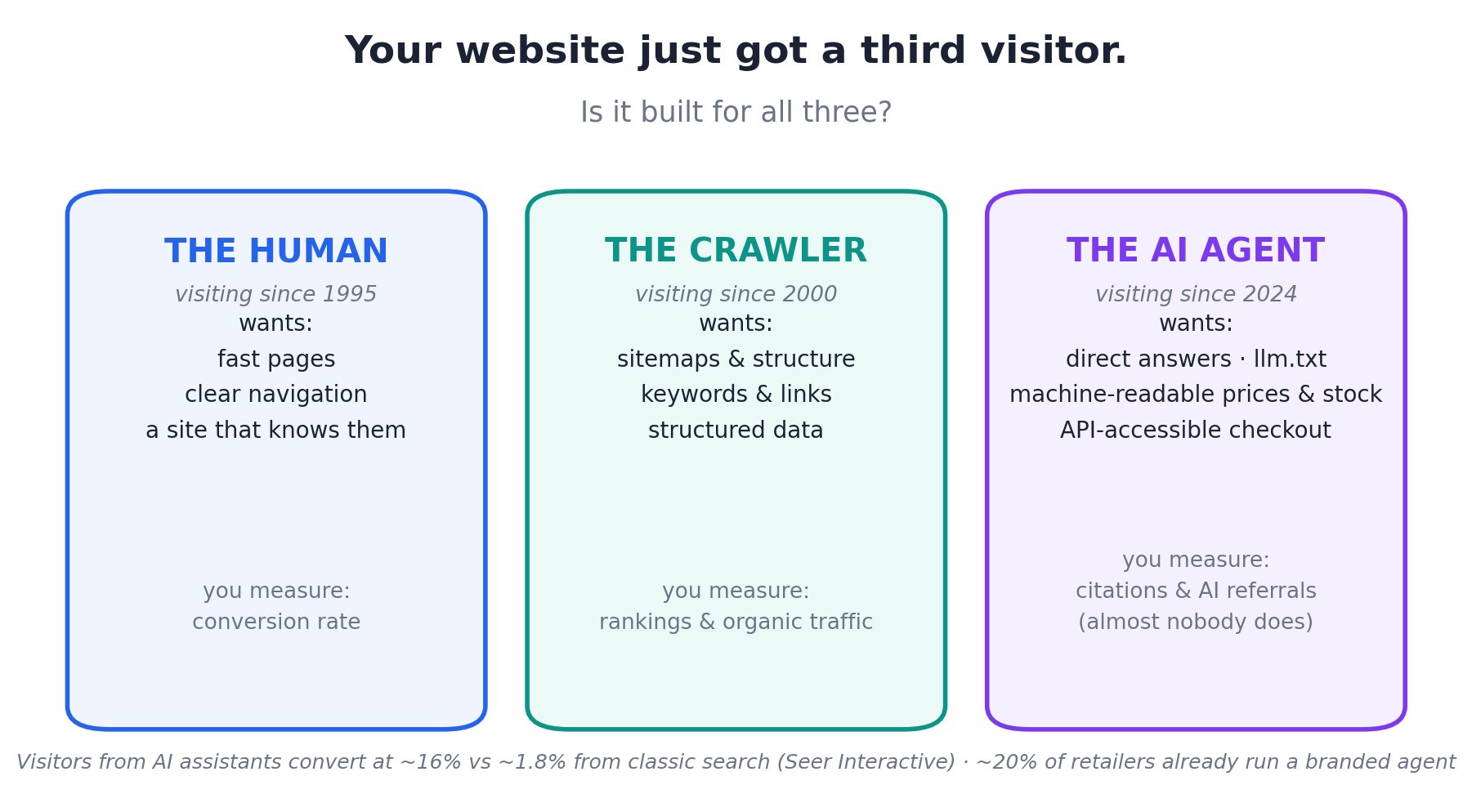
During my month in California this spring, one line from MeasureCamp Los Angeles kept coming back to me: "SEO is more important than ever." A strange thing to hear at an analytics unconference in 2026, until the speaker explained what he meant. Search didn't die. It moved inside the AI assistants, and your website just got a third visitor.
For twenty years websites served two audiences: human beings and Google's crawler. Everything we call CRO and SEO grew out of that pair. The third visitor changes the job. AI assistants read your site to answer questions about your brand, and agentic commerce (AI agents that navigate, negotiate and complete purchases for a consumer) is moving from demo to deployment: about 20% of retailers had a branded agent live by late 2025, and those that did pulled ahead measurably.
Optimising for all three visitors at once is what I mean by Generative AI Website Optimisation. It has three layers.
LAYER 1: BE READABLE, AND CITABLE, BY MACHINES
The numbers say this is worth real money. Visitors arriving from ChatGPT convert at 15.9%, versus 1.76% from classic organic search (Seer Interactive). Citations in AI answers decay fast: Digital Authority Partners tracked 1,127 cited URLs and found only 119 still cited six weeks later. So this layer is operational, not a one-off project: structured data, pages that answer questions directly, emerging conventions like llm.txt and agents.txt, and a monthly check of where your brand shows up in AI answers.
For a sportswear brand the test is concrete: ask any assistant "best running shoes for overpronation" or "best trail shoe for wide feet" and see who gets named. Those answers are the new shelf placement.
LAYER 2: PERSONALISE FOR THE HUMANS
Generative AI raised the ceiling on what personalisation means, and the gap between leaders and laggards is widening: companies at the top personalisation maturity levels earn on average 2.4× more revenue per visitor, and the single step from level 2 to level 3 delivers a median 18% conversion improvement (Growth Engines, 2026).
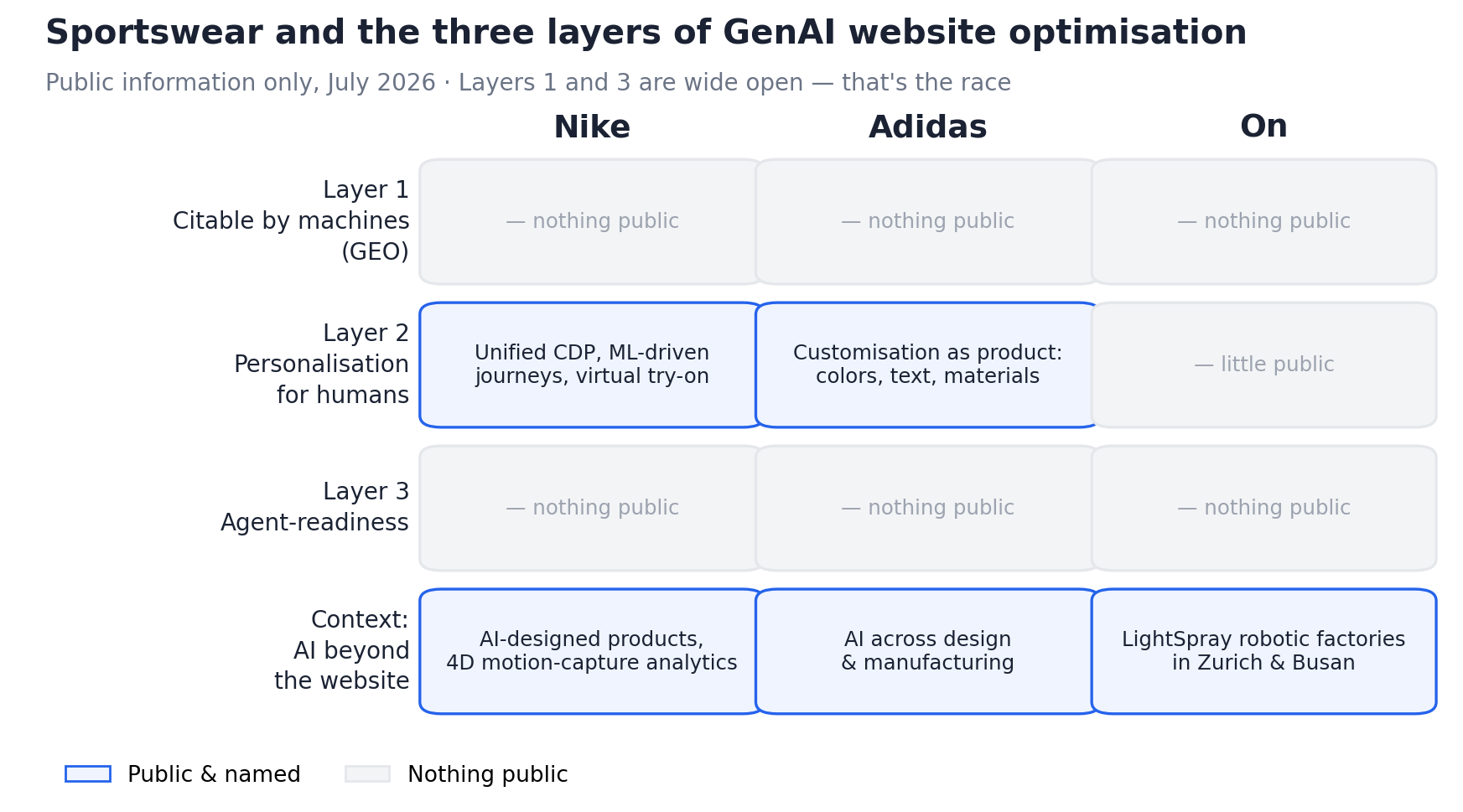
Nike is the reference case. It consolidated its European stack into a unified customer data platform, with ML models orchestrating journeys, recommendations and content across app, web and retail (TechHQ). Its virtual try-on reduces size-related returns, which in footwear is where margins go to die. Adidas took a different route: personalisation as the product itself, letting customers pick colors, text and materials, with AI embedded from design through manufacturing.
LAYER 3: GET READY FOR THE AGENT
The most forward-looking layer, and the least built. At a SaaS talk I attended in San Francisco in May, a founder put it in one line: "prepare to be headless — the customer is the agent." When a shopping agent visits on a customer's behalf, your beautiful homepage is irrelevant. What matters is machine-readable product data, transparent prices and stock, API-accessible checkout, and return policies an agent can parse and compare. The agentic commerce protocols emerging in 2026 are turning this from speculation into a roadmap item.
THE SPORTSWEAR RACE
Why explain all this through sportswear? Because the sector concentrates every ingredient: high-consideration purchases, endless fit and sizing questions (which are pure intent data), premium pricing that needs justification, and brand ecosystems with millions of logged-in members.
The three brands are running different races. Nike leads consumer-facing AI: CDP, personalisation, try-on, a digital member ecosystem. Adidas embeds AI across the value chain, from generative design to manufacturing. On, the Swiss challenger, points its innovation budget at hardware: LightSpray, a robotic process that sprays a one-piece shoe upper and replaces roughly 200 manual production steps, with factories in Zurich and Busan, and a declared "Swiss Innovation Engine" strategy. Its digital and website layer is far less publicised, which makes it the most interesting open question of the three: the brand that answers "which shoe for a 3:30 marathon on wet roads?" as well as its best store staff will own the third visitor in running.
WHAT I'D MEASURE ON MONDAY MORNING
- An AI-referral segment in your web analytics. If ChatGPT and Perplexity traffic sits inside "referral/other", your fastest-growing channel is invisible.
- A monthly LLM citation baseline: 30 buyer-intent prompts, 3 engines, logged in a spreadsheet. One analyst-day per month.
- On-site zero-result searches and unanswered chatbot questions. That's the fit-question goldmine, in the customer's own words.
- Personalisation lift by cohort, not just sitewide conversion. The 2.4× number above is an average of averages; your version of it is the one that matters.
The brands that treated Google as a first-class visitor in 2005 won the following fifteen years of e-commerce. The ones treating AI as a first-class visitor now are placing the same bet, at similar odds.